
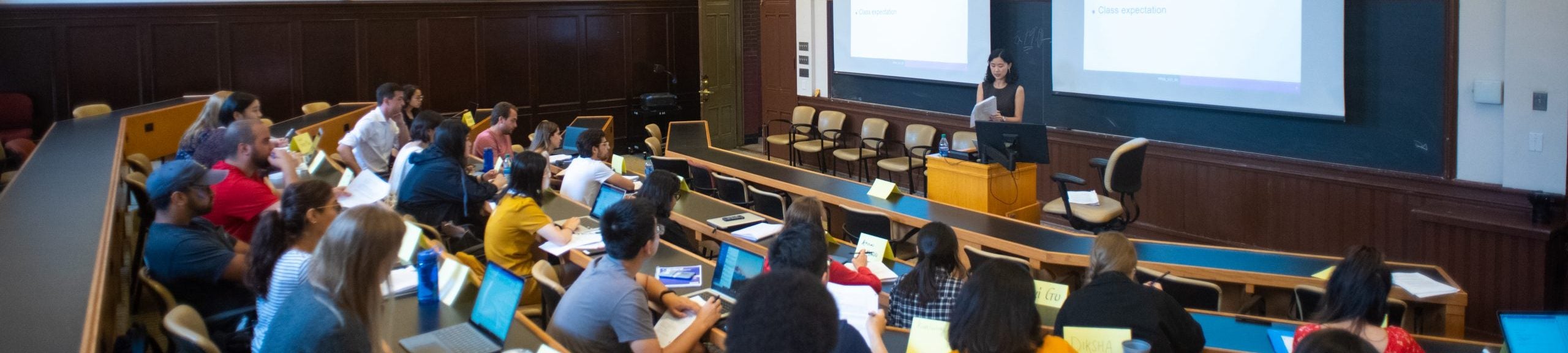
Assessment is nothing more than the imperative to ask the question: How do we know that our students are learning in the way we hope and expect? "Assessment" at Georgetown stands for a focus and commitment to teaching and learning, to improving the ways that we articulate the goals we set for our students and ourselves, and to the transparent ways we discover and share knowledge about how well we are meeting these goals.
Through creative projects for learning more about how and what our students learn, and through innovations and curricular experiments, we are dedicated to building a culture of inquiry around teaching and learning at Georgetown, and see this as vital to maintaining excellence in our curriculum. The Assessment Portal is intended as a gateway to the range of efforts already underway at the university and elsewhere, as well as being a repository of resources related to the assessment of student learning.
Understanding student problem-solving processes
Jim Sandefur, Mathematics
Foundations of Mathematics students had difficulty making the leap from simple to
complex problem-solving. Using an assessment technique called think-alouds, Jim investigated how to
improve students' ability to reason logically about complex mathematical problems, including improving
their reading comprehension and communication skills.
Pre/ Post assessment of student knowledge, confidence, and preparedness
Jen Swift, Chemistry
Jen administered an online knowledge survey at the beginning and end of
the semester in Organic Chemistry II. The survey consisted of 49 proposed tasks (taken from the
syllabus) and 5 sorting questions. Students were asked to rate their confidence level in performing
a given task according to a 3-point scale.
Analysis of the process and value of writing a senior thesis
Biology
For many years the Biology department has required a written senior
thesis that assesses the ability to read primary literature and think analytically and
synthetically. In Spring 2003, the department administered a senior thesis survey to
graduating seniors to assess the value added, effort expended, and mentorship quality
the student experienced in researching and writing a senior thesis.
Redesigning the major according to competencies
German
An ideal approach to curriculum design is to identify not only meaningful
overall outcomes, but specific competencies and evidence of achievement of competencies at each
phase of the curriculum. Such a method of rationalizing according to evidence of learning, along
different important competencies, enables both students and faculty to share the criteria for
learning and understanding.
Curriculum by backward design: Mission, goals, and student data
Sociology & Anthropology
"Backward design" is a curriculum design approach that begins with the desired end.
Using backward design, faculty and programs first articulate the most important concepts, ideas, and
abilities that students are expected to achieve; then they work backwards through the various learning
experiences that are necessary to achieve these results.
Assessing campus climate toward diversity
Diversity Action Council
Members of the Diversity Action Council’s Assessment Committee collect
data from students, faculty, and staff about campus climate; facilitate focus group discussions
of issues around diversity; compile comprehensive reports summarizing diversity initiatives at
Georgetown; and are presently working on the creation of a 'Diversity Progress Report' assessment
tool for campus use.
The important thing is not to stop questioning. Curiosity has its own reason for existing.
—Albert Einstein